String of Pearls Care Guide: Grow Senecio Rowleyanus
String of pearls is one of those plants that looks almost too sculptural to be real — a cascade of perfect green spheres trailing over the edge of a pot like a living curtain. But Senecio rowleyanus has a reputation for being finicky, and honestly, that reputation is partly deserved. Most losses come down to two things: too much water and not enough light. Get those two right, and this plant rewards you with fast, dramatic growth. This guide covers everything from bright indirect light requirements and fast-draining soil to propagating new strands and rescuing pearls that have gone soft or shriveled.
Species Overview & Origin
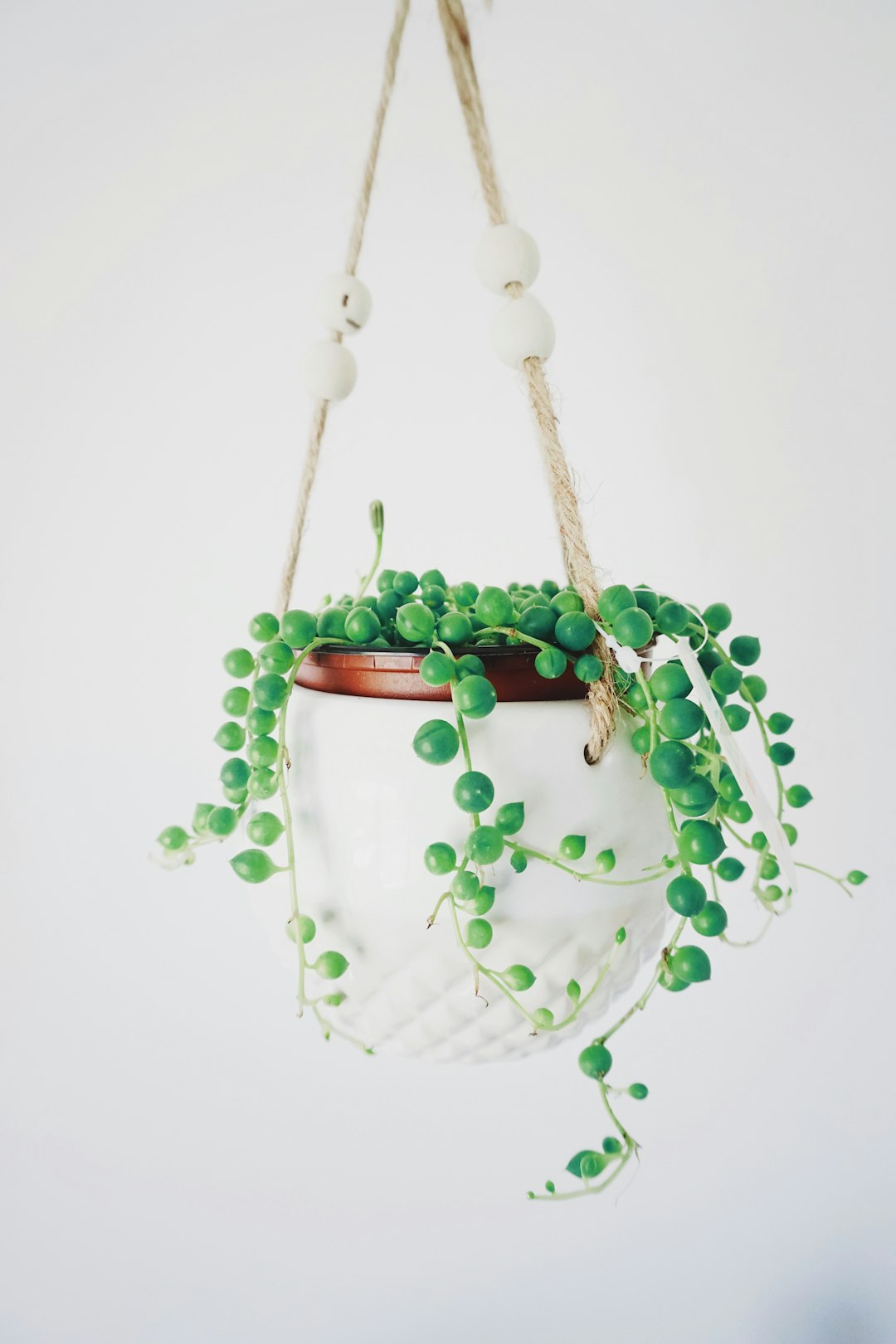
Senecio rowleyanus is a succulent native to the semi-arid regions of southwestern Africa, where it grows as a ground-covering creeper in the dappled shade beneath shrubs and rocky outcrops. In its natural habitat, it rarely experiences prolonged direct sun or waterlogged soil — two conditions that explain almost every care rule you need to follow at home.
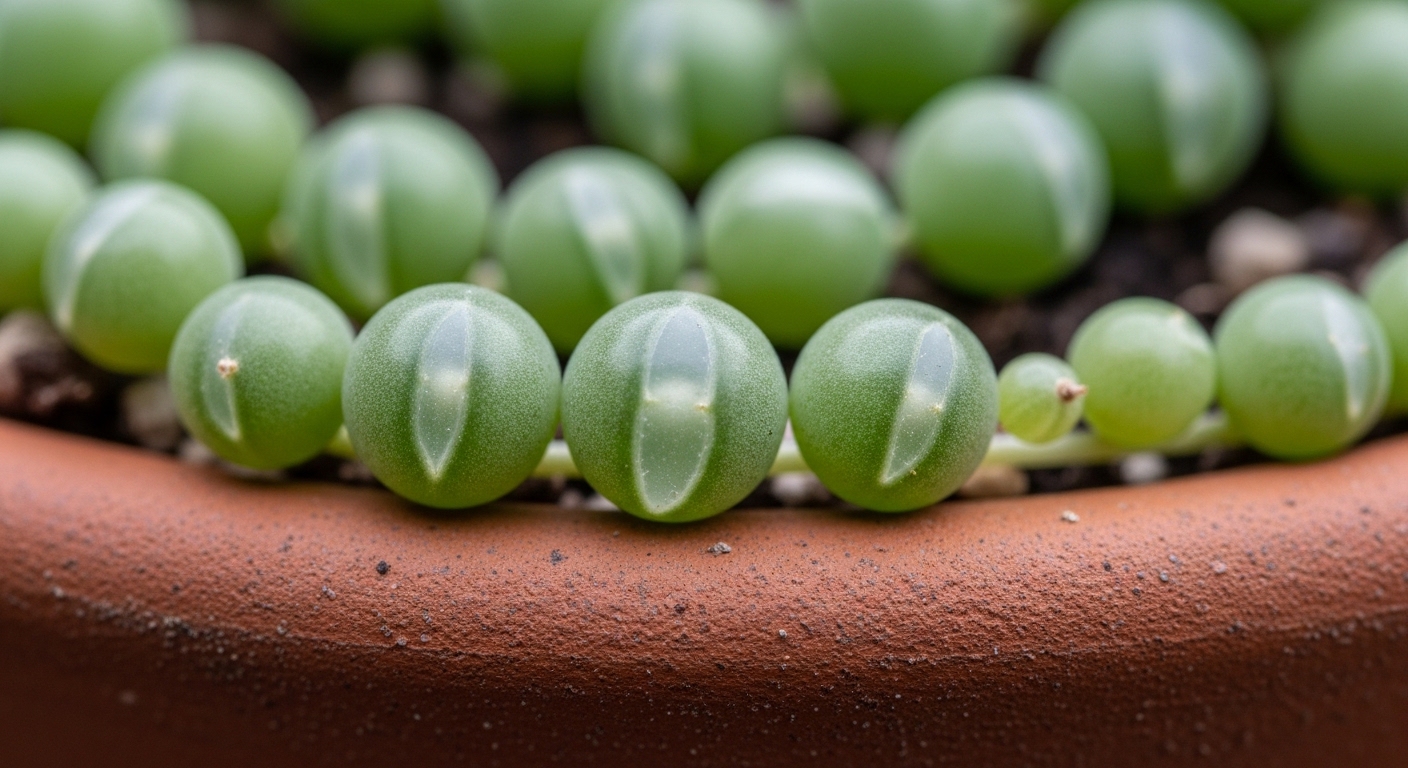
The round bead shape is an evolutionary adaptation. Each pearl is a modified leaf, swollen with stored water to help the plant survive dry spells. Look closely and you'll notice a thin translucent stripe running along each bead — this is called an epidermal window, and it allows light to penetrate into the leaf interior for photosynthesis while minimizing the surface area exposed to drying air. It's a genuinely elegant piece of plant engineering.
The plant belongs to the Asteraceae family, and mature specimens occasionally produce small, white, daisy-like flowers with a faint cinnamon scent. Flowering is more common when the plant experiences a slightly cooler, drier rest period in winter — something worth keeping in mind as the seasons shift.
String of pearls is generally considered toxic to cats, dogs, and humans if ingested. Keep it out of reach of pets and children. For detailed toxicity information, the ASPCA Animal Poison Control Center is a reliable general resource.
Light & Temperature Needs
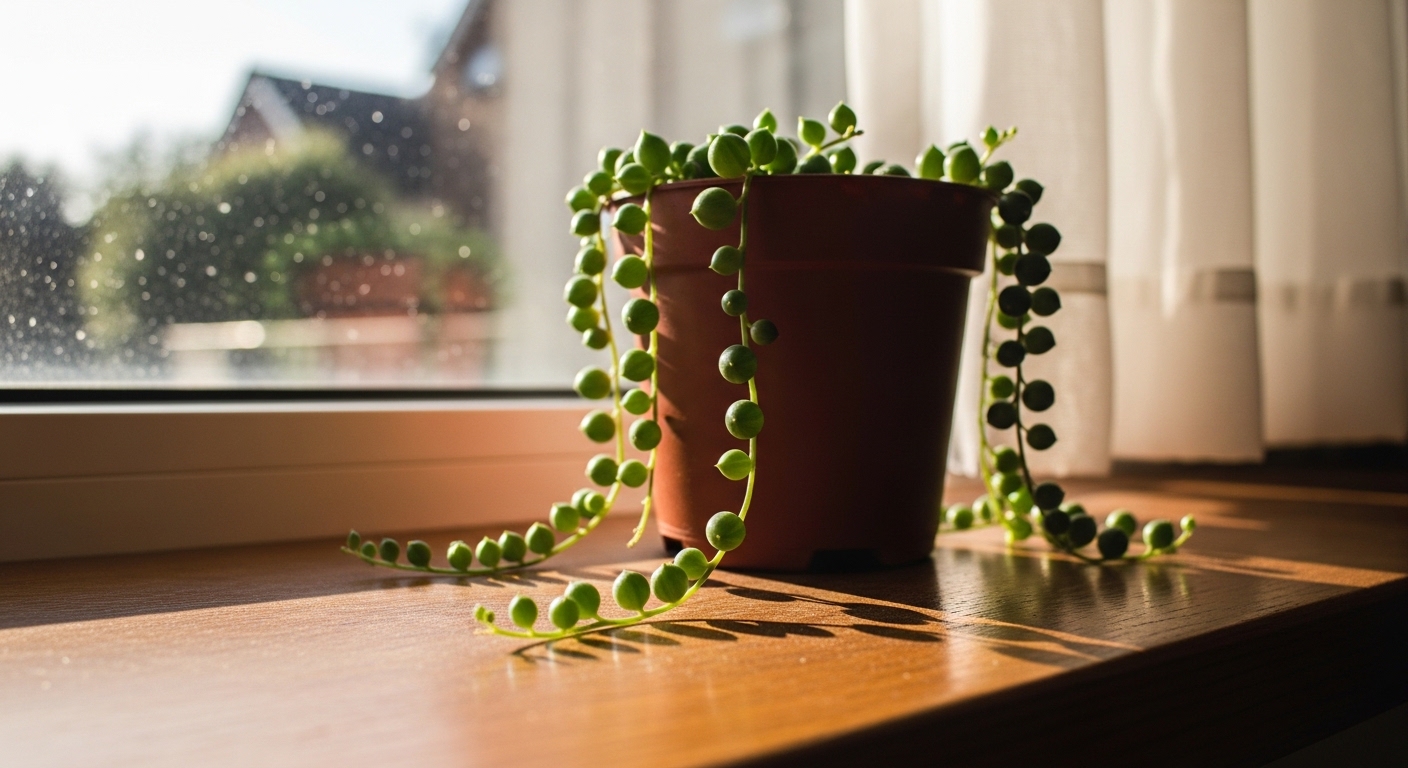
String of pearls needs bright indirect light for most of the day — ideally four to six hours — with some tolerance for gentle direct morning sun. An east-facing windowsill or a spot set back slightly from a south- or west-facing window generally works well in most homes.
Insufficient light is the most common reason pearls become elongated and widely spaced along the strand, a condition called etiolation. The plant is essentially stretching toward the light source, and once a strand has etiolated, it won't compact back. What you can do is propagate from healthier sections and move the plant to a brighter position going forward.
Direct midday or afternoon sun through glass can scorch the pearls, causing papery, bleached patches. If you're placing the plant near a south-facing window in summer, a sheer curtain can diffuse the intensity without blocking too much light overall.
Temperature-wise, Senecio rowleyanus prefers:
- Active growing season (spring–summer): 18–24°C (65–75°F)
- Winter rest period: 10–15°C (50–60°F) encourages dormancy and can trigger flowering
- Avoid cold drafts, air conditioning vents, and temperatures below 7°C (45°F)
Watering & Humidity Guide
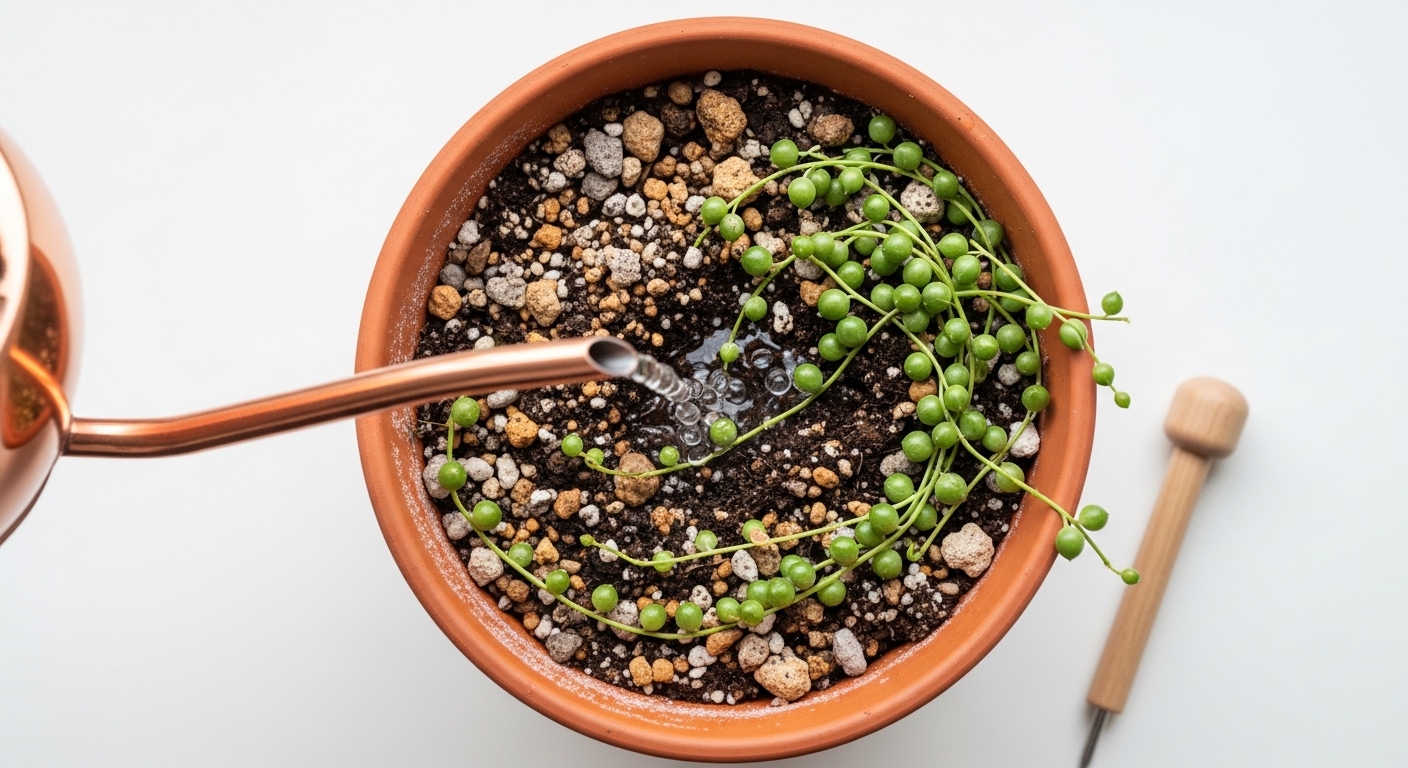
Water string of pearls only when the top 2–3 cm of soil feels completely dry — and in cooler months, wait even longer. When you do water, water thoroughly until it drains freely from the bottom, then allow the pot to drain fully before returning it to its saucer or hanger.
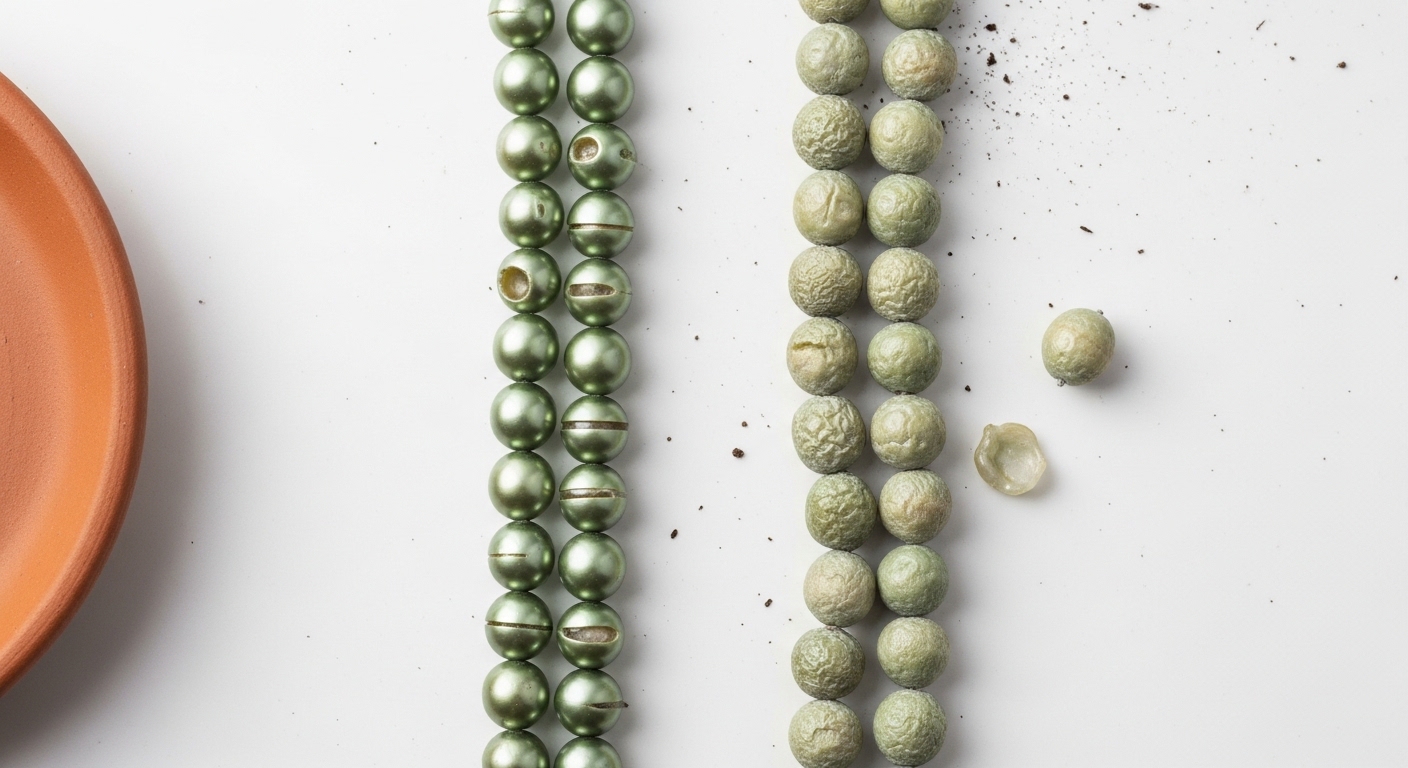
Overwatering is by far the leading cause of death for this plant. The pearls store water internally, so they can tolerate drought far better than excess moisture. One frustrating part is that both overwatering and underwatering can cause pearls to shrivel — but the texture tells you which problem you're dealing with. Soft, mushy pearls with darkening strands signal rot from too much water. Firm but wrinkled pearls that feel slightly papery indicate the plant is genuinely thirsty.
Humidity is generally not a concern. String of pearls evolved in dry environments and does not benefit from misting — in fact, misting the pearls directly can encourage fungal issues. Normal indoor humidity levels (30–50%) are fine. If your home is very dry in winter due to central heating, the plant will likely not complain.
A practical seasonal watering rhythm many growers find useful:
- Spring–summer: Water every 10–14 days, checking soil moisture before each watering
- Autumn: Gradually reduce frequency as growth slows
- Winter: Water sparingly, roughly every 3–4 weeks, allowing soil to dry almost completely
Soil, Potting & Fertilizing
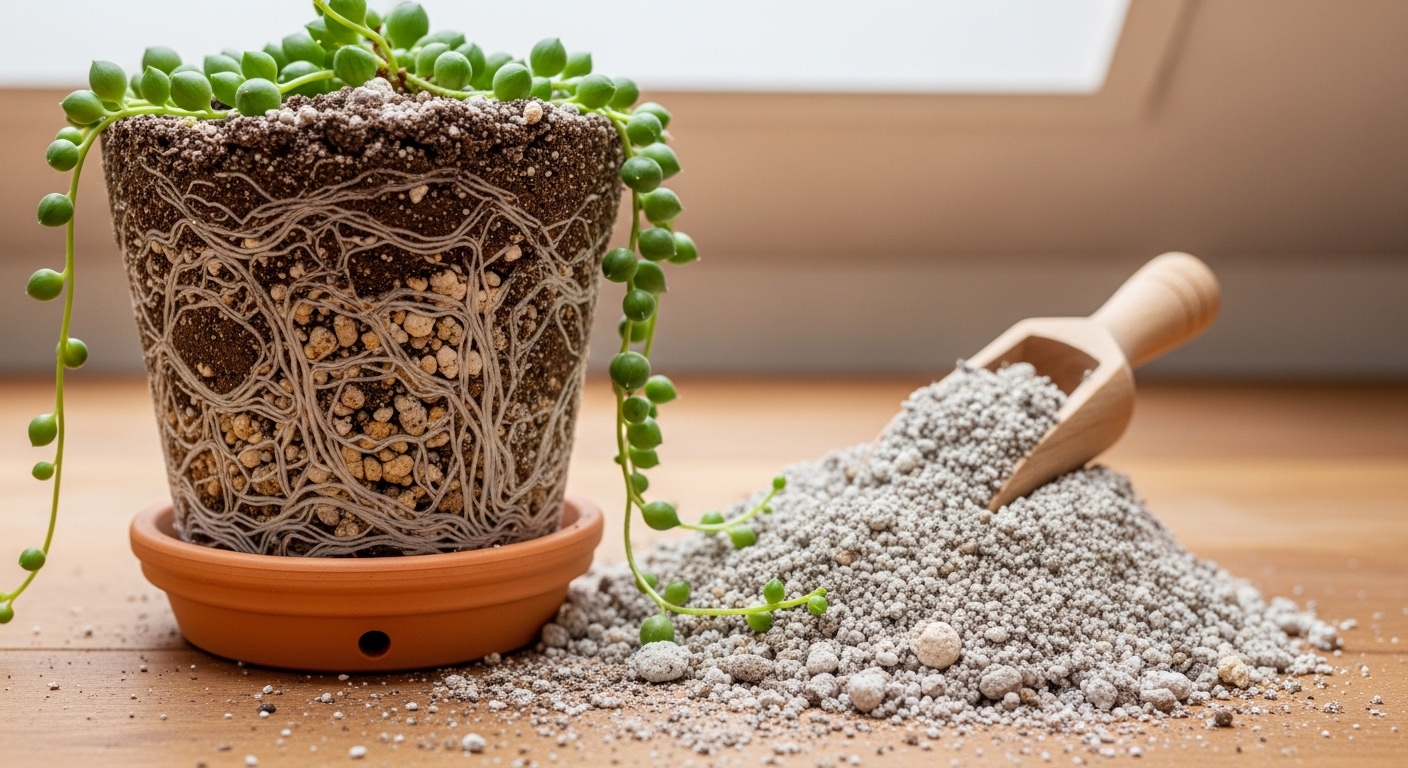
Fast drainage is non-negotiable. A standard potting mix holds too much moisture for Senecio rowleyanus and will almost certainly lead to root rot over time. The goal is a mix that drains quickly but still holds just enough structure to anchor the shallow root system.
A reliable DIY mix: combine one part standard potting soil with one part coarse perlite and one part horticultural grit or coarse sand. Many growers also add a small amount of pumice for additional aeration. The finished mix should feel gritty and loose, not dense or clumping.
Pot choice matters too. Terracotta is generally the better option over plastic or glazed ceramic — the porous walls allow excess moisture to evaporate through the sides, reducing the risk of waterlogging. Ensure the pot has at least one drainage hole. Hanging planters work beautifully for this plant, both aesthetically and practically, as they promote airflow around the pot.
Repot only when the plant has clearly outgrown its container — string of pearls actually tends to grow better when slightly root-bound. Spring is the best time to repot, and moving up just one pot size at a time is usually sufficient.
For fertilizing:
- Feed monthly during spring and summer with a balanced liquid fertilizer diluted to half strength
- A fertilizer formulated for succulents or cacti works well
- Do not fertilize during autumn or winter when the plant is resting
- Over-fertilizing can cause soft, weak growth — less is genuinely more here
Common Problems & Fixes
Most issues with string of pearls come back to water or light. But knowing exactly what you're looking at makes the difference between a quick fix and losing the plant entirely.
Shriveled, wrinkled pearls (firm to the touch): The plant is underwatered or has been in very low humidity for an extended period. Water thoroughly and allow the soil to drain completely. Pearls should plump back up within a few days.
Soft, mushy pearls or blackening strands: Root rot from overwatering. Remove the plant from its pot, trim away any black or mushy roots with clean scissors, allow the root system to air-dry for 24 hours, then repot into fresh, dry gritty mix. Hold off watering for at least a week.
Widely spaced, elongated pearls: Etiolation from insufficient light. Move the plant to a brighter location. Propagate from any healthy, compact sections of the strand.
Pearls dropping off easily: Often a sign of overwatering, physical disturbance, or cold drafts. Check watering habits and placement.
Yellowing strands: Can indicate overwatering, nutrient deficiency, or natural die-off of older growth. Assess watering frequency first before adjusting anything else.
Pests are relatively uncommon but not unheard of. Mealybugs occasionally appear in the joints between pearls and the strand. Many growers find that dabbing affected areas with a cotton swab dipped in isopropyl alcohol is effective for small infestations. For larger outbreaks, neem oil solution applied carefully to the affected areas may help — avoid soaking the soil with it.
- Always check new plants before bringing them near your existing collection
- Inspect the undersides of strands and the soil surface regularly
- Quarantine any plant showing signs of pest activity
Frequently Asked Questions
How do I propagate string of pearls?
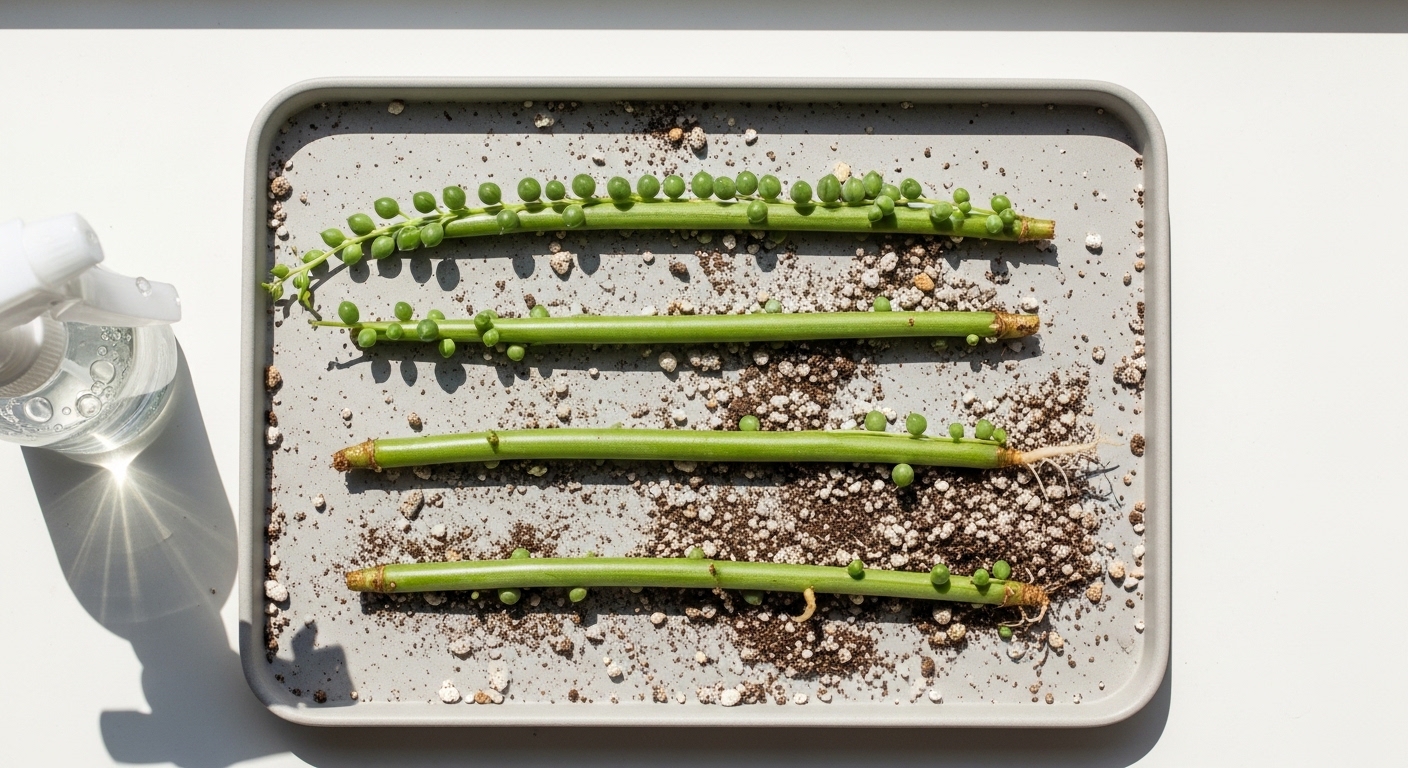
Propagation is straightforward and one of the most satisfying things about this plant. Take a healthy strand 8–10 cm long, remove the pearls from the bottom 2–3 cm to expose the bare stem, and lay the strand on top of moist gritty soil — do not bury it deeply. Keep the soil barely moist and place the cutting in bright indirect light. Roots typically develop within 2–4 weeks. Many growers find that laying multiple strands across the soil surface at once produces a fuller, bushier plant faster than a single cutting.
Why are my pearls falling off when I touch them?
Pearl drop is usually a stress response. The most common causes are overwatering, cold shock, or physical disturbance during repotting. If the plant is otherwise healthy, a little pearl loss is normal. If entire sections of strand are dropping, assess your watering frequency and check for root rot.
Can string of pearls grow in low light?
It can survive in lower light conditions, but it will not grow well. Strands become etiolated — long gaps between pearls, weak stems, reduced vigor. For the plant to genuinely grow and look its best, bright indirect light is necessary. A grow light on a timer can supplement natural light in darker spaces; follow manufacturer instructions and consult a licensed electrician if any hardwiring is involved.
Does string of pearls flower indoors?
It can, though flowering indoors is less common than in outdoor or greenhouse settings. A cooler, drier winter rest period — temperatures around 10–13°C and reduced watering — tends to encourage flower development in spring. The flowers are small, white, and carry a faint sweet scent that many people find surprisingly pleasant.
How fast does string of pearls grow?
In good conditions — bright light, appropriate watering, active growing season — strands can extend several centimeters per month. Growth slows considerably in winter. It is genuinely a fast grower for a succulent, which makes it rewarding once you have the care dialed in.
Closing
String of pearls asks for very little — bright light, fast-draining soil, and the patience to let it dry out between waterings. Once those fundamentals click, the plant practically takes care of itself through the growing season. Start by checking your light situation: if the strands are stretching or spacing out, that is your clearest signal to move it closer to a window. If you are also curious about other trailing succulents that share similar care needs, exploring Senecio herreianus (string of watermelons) or Curio radicans (string of bananas) is a natural next step. There is something quietly satisfying about watching a single healthy strand become three, then ten — a small, living thing doing exactly what it evolved to do.


Comments
Post a Comment